– By Dr Kathryn Royal, Senior Research Officer at Surviving Economic Abuse and report author
Employer responses to domestic, including economic, abuse can be a matter of life or death. Our new report, Hidden Risks, Fatal Consequences, reveals for the first time how economic abuse is a key risk factor in domestic homicides and domestic abuse-related suicides, and how perpetrators weaponise the victim’s employment as part of a pattern of control.
Domestic Homicide Reviews (DHRs) (soon to be renamed Domestic Abuse Related Death Reviews in recognition of people who die by suicide as a result of domestic abuse) are a statutory review, held when a person over 16 dies because of violence, abuse, or neglect by a family member, intimate partner, or someone they lived with.
During my time representing Surviving Economic Abuse (SEA) on the Home Office’s Quality Assurance Panel, I read hundreds of DHRs. These included where victims had experienced economic abuse, a devastating form of domestic abuse involving a perpetrator’s restriction, sabotage, and exploitation of a victim’s economic resources (including money and the things that money can buy). This in turn limits their independence and ability to leave an abuser. These behaviours can extend to a victim-survivor’s employment, as we have previously shared with EIDA’s audience, and can negatively impact their work performance.
Our research: Homicide and suicide risk among victim-survivors of economic abuse
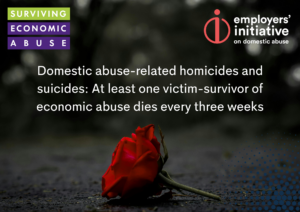
Over half of DHR victims had experienced economic abuse from an intimate partner. This is equivalent to a victim of economic abuse from a current or former partner dying every 19 days. However, fewer than half of DHR panels recognised the economic abuse in these cases. We saw repeated missed opportunities by professionals to recognise and respond to the victim’s experiences of economic abuse.
What do our findings mean for employers?
The importance of the role of employers was repeatedly shown. Perpetrators forced victims to quit their jobs, harassed them at work, and sabotaged their ability to work, including by being unreliable with childcare. For example, one perpetrator turned up at the victim’s workplace to threaten her into withdrawing an application for child maintenance. In another review, the perpetrator, despite being financially dependent on the victim, demeaned her area of work. He also discouraged her from taking employment opportunities that involved travelling or evening work, which significantly limited her ability to earn. Another review highlighted the importance of a positive response from an employer. They were understanding, providing the victim with practical support, such as changes to her working pattern and sharing information with her about on-site security.
It’s imperative that employers learn how to recognise signs of economic abuse and support employees. You can read more about the impacts of economic abuse on employees, and how employers can help, in our recent guest blog for EIDA.
SEA also has a range of resources that can help employers, including our free online resources. We also offer a range of training for employers on economic abuse awareness. If you would like to learn more about our training and how we can support you, please contact us.
By recognising economic abuse and providing appropriate support, employers can play a vital role in supporting victim-survivors. This can save lives. As our research shows, economic abuse kills – but it does not have to. Together, we can stop more lives from being lost.